
Public value
Public value begins when more families can turn opportunity into participation.
Huddle frames public value as a testable participation hypothesis with explicit beneficiaries, safeguards, evidence needs and stop conditions.


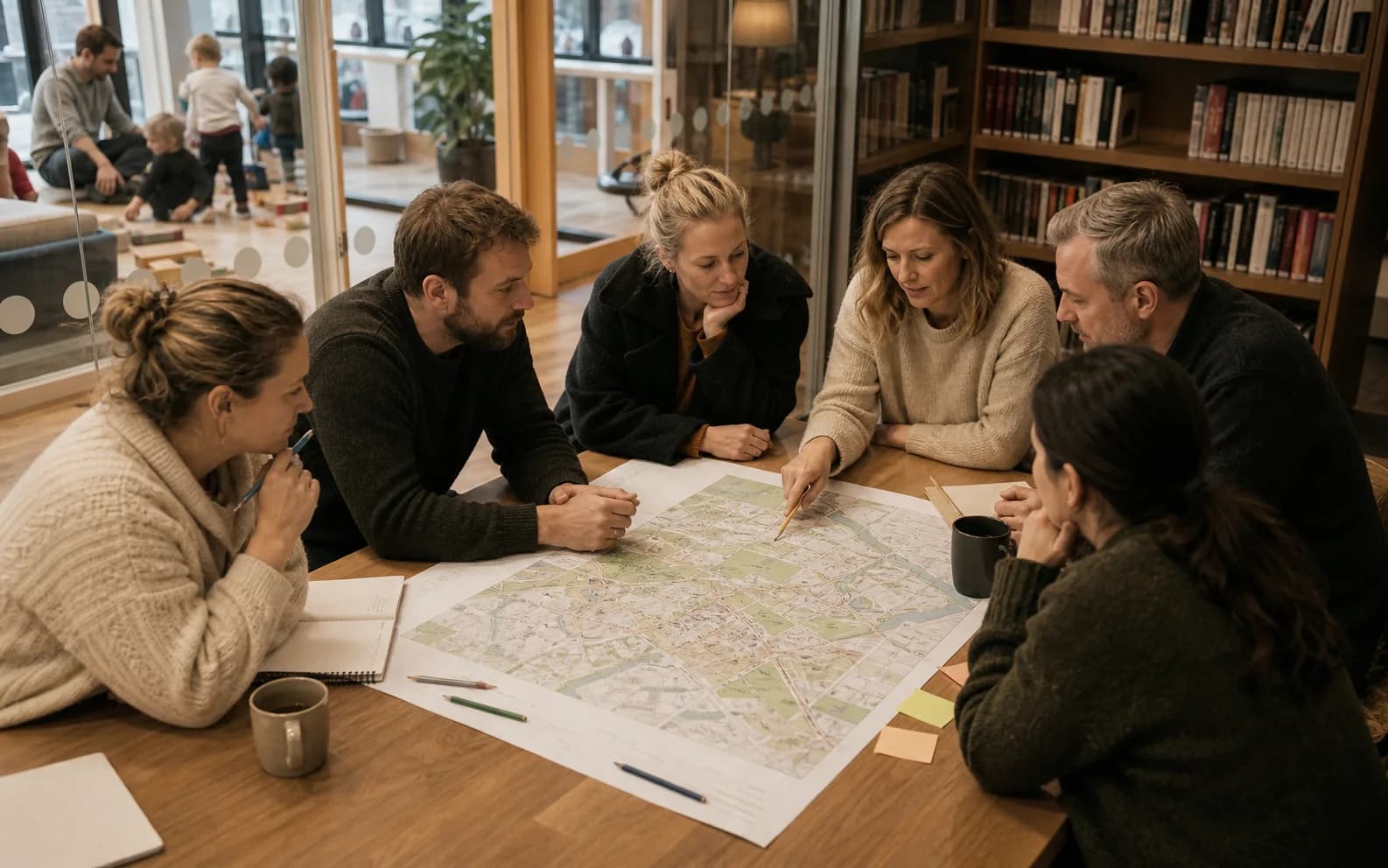
The existence of local opportunities does not guarantee that families can reach them.
The proposed value lies in a clearer route from intention to local participation.
Public value must be measured across access, experience, distribution, cost and unintended effects.
The public question
The existence of local opportunities does not guarantee that families can reach them.
Families may face fragmented information, unclear cost, transport, equipment, language, accessibility or uncertainty about the first visit. These barriers can affect who participates even where activities and support already exist.
A public-value case for Huddle therefore begins with a specific local problem and the groups affected by it. General statistics may describe the context, but they cannot establish the cause of the barrier or prove that Huddle is the right response.
What could improve
The proposed value lies in a clearer route from intention to local participation.
Huddle could help families compare relevant opportunities, understand practical conditions, prepare for a first visit and find routes around common barriers. Organisations could gain a clearer standard for information that families repeatedly request.
For a municipality, aggregated learning could reveal where information or access repeatedly breaks down and support better questions about local provision. These are proposed benefits to test, not verified improvements, efficiency gains or outcomes.

Evidence before claims
Public value must be measured across access, experience, distribution, cost and unintended effects.
A credible evaluation should define who the initiative is intended to help, what changes are expected, what remains outside Huddle’s control and which comparison or baseline is appropriate. It should examine whether some groups benefit less or carry more effort or risk.
Huddle does not currently claim increased participation, improved wellbeing, municipal savings, reduced workload or proven inclusion. A pilot discussion is not evidence of public value, and funding or procurement decisions require their own lawful and documented process.