
Local participation ecosystem
A local participation ecosystem connects what already exists without taking it over.
The municipal role is to clarify public purpose, local boundaries and accountable collaboration around family participation.


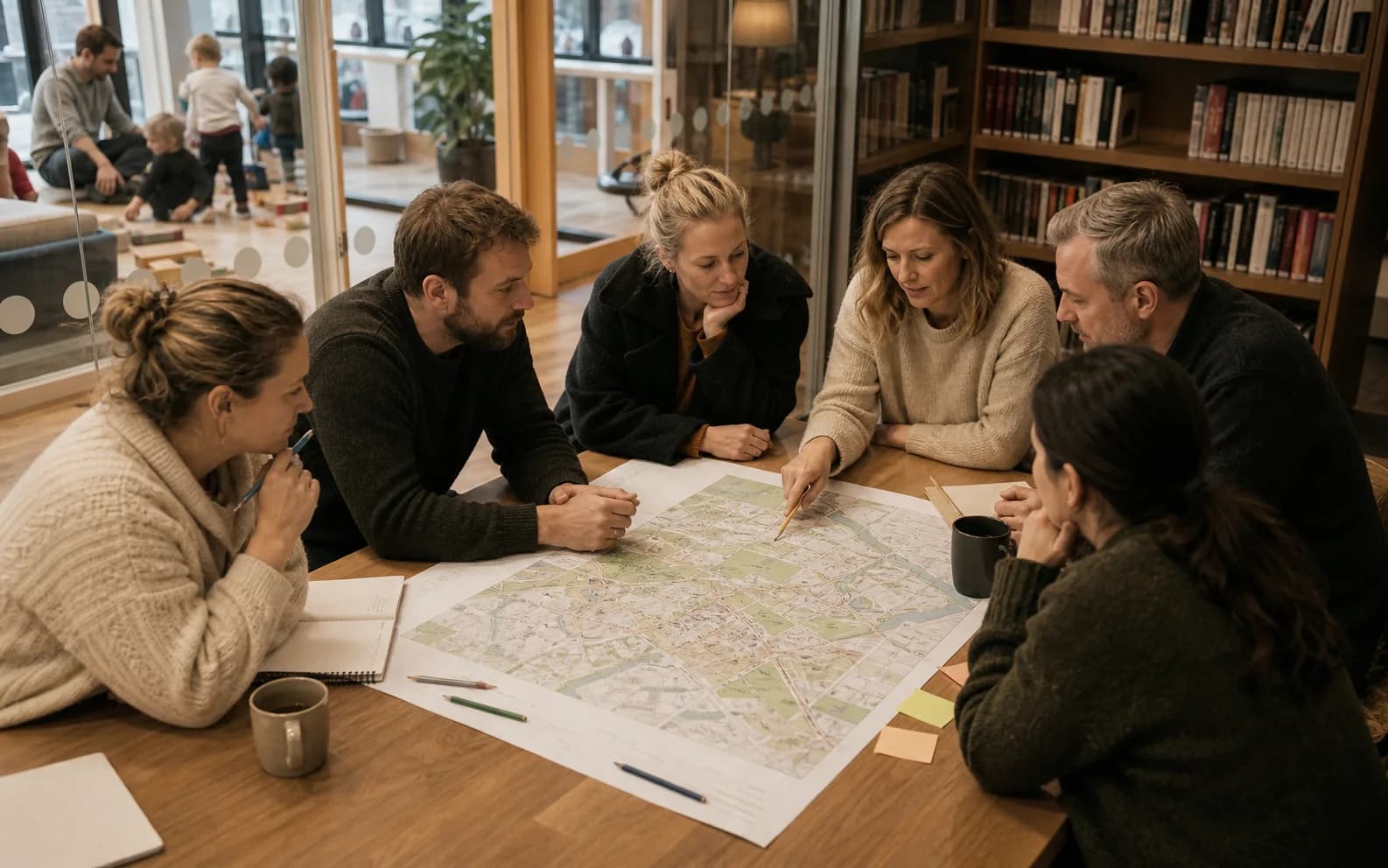
Families should be able to understand the local path even when responsibility is shared across many actors.
Better coordination depends on accountable information, not a new central owner of every service.
Begin with a shared problem map and a narrow question that can be tested.
A connected local picture
Families should be able to understand the local path even when responsibility is shared across many actors.
A municipality may already have activities, public services, voluntary organisations, cultural venues and support schemes, while families still need to search across separate websites, messages and offices. The public challenge is often a fragmented route, not a complete absence of provision.
Huddle proposes a participation layer that can explain opportunities, practical conditions and routes to support in one understandable journey. It is intended to help people reach existing local resources, not to replace municipal casework, professional judgement or the organisations that deliver them.
Clear responsibility
Better coordination depends on accountable information, not a new central owner of every service.
Municipal sources should remain authoritative for municipal facts, while clubs and service providers remain responsible for their own schedules, prices, eligibility and first-visit information. Families should be able to see who supplied material information and when it was last confirmed.
The municipality should not receive a family profile in return for helping improve local participation. Any future shared information model needs defined responsibilities for accuracy, correction, access, retention and communication when an opportunity changes.

A responsible first step
Begin with a shared problem map and a narrow question that can be tested.
A useful first conversation can map existing services, information owners, repeated family questions, excluded groups and the points where people abandon the journey. It should also identify duplication and existing municipal systems that Huddle must respect.
This dialogue is exploratory. It is not a procurement, partnership, commissioned pilot or municipal endorsement. No implementation, service improvement or participation effect is claimed until scope, authority, safeguards, resources and evaluation have been agreed and tested.